
Re-thinking what nervous system regulation means
Inviting a Shift From The Rigid Illusion of “Control” To a Gentler, More Compassionate Flow With Somatic Therapy
Regulation
The term "regulate," according to Merriam-Webster, is a transitive verb that means "to govern or direct according to rule" or "to bring order, method or uniformity to."
Synonyms, also according to Merriam-Webster?
"Suppress."
"Stifle."
"Control."
"Restrain."
I often engage with new therapy clients who say they're looking for support with emotion or nervous system regulation. I inquire into specificity, because one’s concept of "regulation" in this case may align with mine, or it may align more with ol' Merriam-Webster's.
(And as a small aside, nervous system regulation and emotional regulation are two separate concepts, but they can be appreciated as working together, like Nemo and Dory. As such, they’re a bit interchangeable for the purposes of this article).
I find myself in the company of people expressing sentiments of pain, overwhelm, self-judgement, and disgust as they describe their "out-of-control" selves. Running from anxiety daily, irritation simmering until it is uncontainable, longing to be present with loved ones without disappearing when friction arises.
They share about the ways they've attempted to cajole, argue, rationalize, punish, and pep talk themselves into some tidy, polished presentation of a human. Yet, even when they’re successful with battening down the hatches, something feels amiss.
In capitalist patriarchy, worth is (presumably) proven by how hard you hustle, how busy you are, how relentless you self-sacrifice.Our collective concept of emotional regulation equates to collective gaslighting. We override pangs of loneliness and the ache for honest connection with ourselves and others, in favour of being seen as reasonable, agreeable, and good.
The Compulsion to Fix
The impulse to better control emotions is sometimes driven by the sense that they can be so damn uncomfortable and inconvenient.
Get up without hitting snooze, tend to the dependants, walk the dog, meal plan and meal prep, wipe the finger smudges off the walls and dust the baseboards*, get to work on time, nail the presentation, gracefully accept more responsibilities after said presentation, get home in time to navigate nosey neighbour Nellie's** third degree, smile through the parent-teacher meeting, oversee homework (how to do long division ten different ways?!), make dinner, serve dinner, ignore at least one eyeroll regarding what's for dinner, clean up dinner, consume the latest media without imploding from fear, make it to the soccer game with the orange slices...
...And all while also tending to the ups and downs of an emotional life.
And ever notice that when you're already feeling under pressure, circumstances test you further? You're particularly anxious about a work meeting, and your child announces willfully at breakfast that they're most definitely not going to school that day.
Now you're tending to your emotional life and theirs.
We're convinced that others have it more together than we do. Though we joke and send each other memes about life's chaos and #IYKYK, we're most definitely the biggest dumpster fire and the only one who lays awake at night replaying all of the ways we lost our shit, or failed as a partner/parent/colleague/friend.
We don't like how it feels when we're not in control. We think if we hustle harder and tighten the reigns on our life, if we fixed these sloppy emotions, we’d finally be okay.
Enter, Emotional Regulation into the search.
A (very) simplified overview of the nervous system
Sympathetic activation & parasympathetic rest: the gas and brake pedal
The sympathetic branch of the autonomic nervous system is like “the gas.” We need this energy to play, work, create, and otherwise "adult."
The parasympathetic branch of the system can be likened to the brake pedal. It deactivates sympathetic charge to allow for rest, digestion, connection, and settling.
In ideal day-to-day relative safety, the sympathetic and parasympathetic branches work in harmony to provide vital life force as well as necessary rest and nourishment. There is a rhythmic ebb and flow of expansion and contraction.
The Window of tolerance
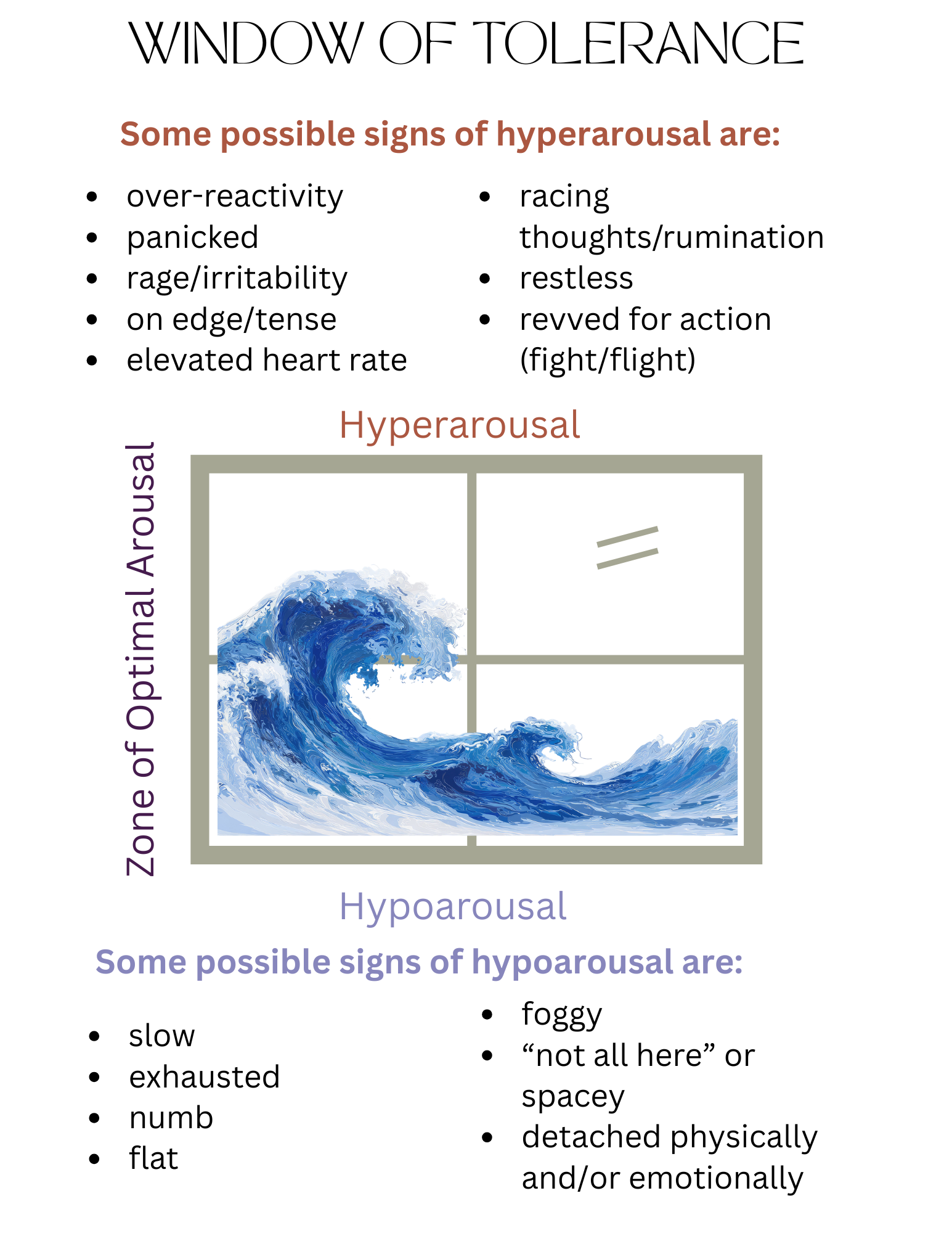
We can think of the frame within which the "ideal" and balanced flow of sympathetic charge and deactivation as our window of tolerance. Within it, we can be said to be regulated.
The window isn't a depiction of complete ease, comfort, or saint-like composure. However, when in our "window," there is capacity to be in our experience and stay with ourselves. We can surf the waves of life, with some moments choppier than others. We're present to the moment as it is, not continuously racing ahead to some imagined future or perpetually haunted by the past. We can experience discomfort as a signal for curiosity, not necessarily a pathology to blot out. We're able to attend to ourselves (and others) in self-responsible ways.
Nervous system dysregulation
When our system detects a (real or imagined) potential threat, the level of sympathetic activation increases and sometimes breaches our window of tolerance. High levels of sympathetic charge help us to be vigilant, run, or fight for survival.
In cases where escape is not possible or safe, an internal emergency brake engages to hold in the energetic charge, and we may freeze, fawn, or collapse as a means of survival.
When danger has passed, our nervous systems are designed to deactivate and clear unnecessary charge, returning to a state of homeostasis.
Both acts of activating survival responses and returning to baseline are subcortical operations. This means we're not consciously controlling the processes, but rather the wisdom and rhythm of the body take over.
Chronic dysregulation can occur when the nervous system becomes "stuck" in survival patterns and cannot get back to a baseline of safety. We have great difficulty finding our surfboard and riding the waves.
This may look like:
hyper-vigilance or being on edge
having difficulty settling the body or mind
experiencing racing thoughts or worries
chronic muscle tension, pain, inflammation
being irritable and easily provoked
feeling apathetic or having low energy
feeling spacey or numb
engaging in behaviours that bring initial relief but longer-term suffering
and so on
There are many reasons why a system might become stuck in dysregulation.
There are many reasons why a person may need to be in survival mode.
Dysregulation is information to be curious about, not proof of personal failure or brokenness.
Survival Responses and Body Wisdom
Something to consider about the state of the world and systemic structures of power:
It’s not a coincidence that so many bodies have learned to be vigilant, walk on eggshells, brace with fear, suppress the instinct for healthy aggression, and soften vocal tone and delivery.
We do a huge disservice to ourselves and others when we assume psychological/emotional/physical safety is the norm for all people, in all places.
Some bodies learn to tolerate the intolerable because being in survival mode is a non-negotiable, and navigating those waves daily by any means necessary is a journey unto itself. Dysregulation can be the wisest automatic response and needn’t be seen as pathological.
Why “Control” doesn’t work
When we think of "controlling" our emotions or nervous system state as the antidote to dysregulation, we're meeting heightened activation with more of the same thing. Our system is in a survival response of fear, and we double down on adding more fuel to that fire.
Imagine for a moment that your dearest friend comes to you, their voice filled with panic, eyes wide with terror. As you orient your attention to them, you're taken by how vulnerable and desperate they are for relief.
What happens inside of you?
How would you respond to them?
Would you raise your voice and insist they get a hold of themselves?
Or would you soften and listen more deeply?
Would your curiosity be piqued to get a better sense of what is happening for them?
Tending to a friend's distress with curiosity and care requires that we notice what comes up in us. When one person is hyjacked in a fear response, we may find our body responds with fear as well. It's not uncommon to want to control others' emotions as well as our own, if only in desperate search of personal relief.
Coming Back Home
Moving back into the window of tolerance requires relative safety to be present and feel our experience, whether we're able to provide that for ourselves, or we seek support from a trusted other. (By the way, pets and trees count as "trusted other").
One of many possible routes for nervous system support is somatic informed psychotherapy with a provider who is trained and mentored in ways that are trauma-sensitive. The terms “somatic” and “trauma-informed” have become pop psychology and wellness trends, in some cases added as a marketing phrase to yoga classes or coaching programs. You might take care to research or inquire about the extent of training a practitioner has, and if they’re accountable to regulatory frameworks or boards.
Somatic therapy is not a means of getting tools to restrain (inconvenient) emotions, but rather a journey of growing the capacity and skill to be with what arises in this messy, joyful and sometimes inconvenient life. It can be a pathway for completing long-held survival responses, processing emotional material from the past that overshadows the present, and finding ways of relating to self and others with more clarity and integrity. In cases of ongoing trauma, somatic practices can deepen a person’s access to resource and support the body in touching into moments of reprieve.
At Core Clarity Psychotherapy & Counselling, support moves beyond simply understanding your experience intellectually. Learning how to stay present, trusting you can open and come back again and again when friction and tension occur, is immeasurably more satisfying than cramming yourself (or others) into a box of self-denial via the illusion of control.
You'll never hustle your way out of your humanity. The emotional experience is here to stay.
The question is, do you dare keep your eyes and your heart open for it?
**I'm currently interviewing for anyone motivated to wash my walls and dust baseboards.
*apologies to all Nellies; your name just happened to be the first that matched the alliteration.